IFRA 51st amendment essential oils compliance comes down to two questions. First, is any oil you buy affected? IFRA’s Standards restrict individual fragrance ingredients, so an essential oil is affected only through the constituents it contains, and the public notifications for the 51st Amendment do not name oils. Second, can your supplier prove it? Ask for a batch-specific IFRA Certificate of Conformity that names the amendment it was written against, plus a COA with GC-MS data.
This guide explains what the 51st Amendment changed, how to work out whether a given oil is exposed, which documents to ask for, and why the 52nd Amendment, which names eight oils directly, already matters for anyone buying in 2026.
What did the 51st Amendment change?
IFRA notified the 51st Amendment on 30 June 2023. According to IFRA:
| What changed | Count |
|---|
| New Standards restricting fragrance ingredients | 47 |
| New Standard specifying the use of a single ingredient | 1 |
| Ingredient prohibited (safe levels could not be set) | 1 |
| Existing Standards revised | 11 |
| IFRA Standards in total | 263 |
All IFRA Standards are based on safety assessments by RIFM (the Research Institute for Fragrance Materials) and reviewed by an independent expert panel. Secondary sources quote slightly different counts of revised Standards, so use IFRA’s own figures when you cite them.
The compliance dates, as reported by UL, Obelis and Lisam, are:
| New creations | Existing creations |
|---|
| Prohibited ingredient | 30 Aug 2023 | 30 Jul 2024 |
| Restricted or specified ingredients | 30 Mar 2024 | 30 Oct 2025 |
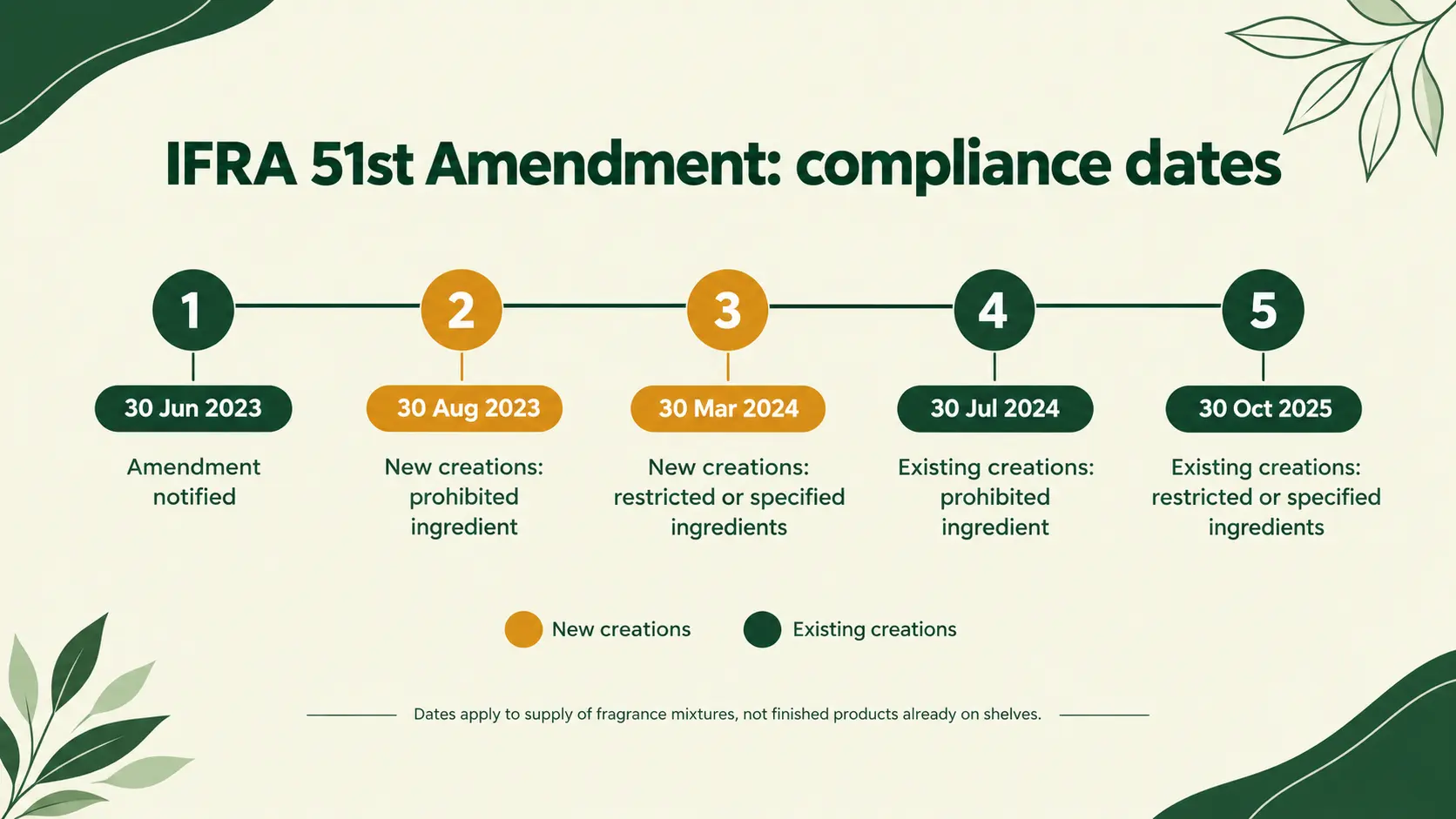
These dates apply to the supply of fragrance mixtures, not to finished products already on shelves. As of October 2026 every one of them has passed, and IFRA’s Standards page still lists the 51st as the latest amendment. IFRA Standards are an industry safety programme rather than legislation, but many brands, retailers and importers write them into purchase specifications.
Which essential oils does the 51st Amendment affect?
No public IFRA summary of the 51st Amendment gives a list of affected oils. The logic runs the other way. A Standard sets a maximum level for a chemical, and an essential oil, which is a natural complex substance, is affected when it contains enough of that chemical to push the finished product past the limit for its category.
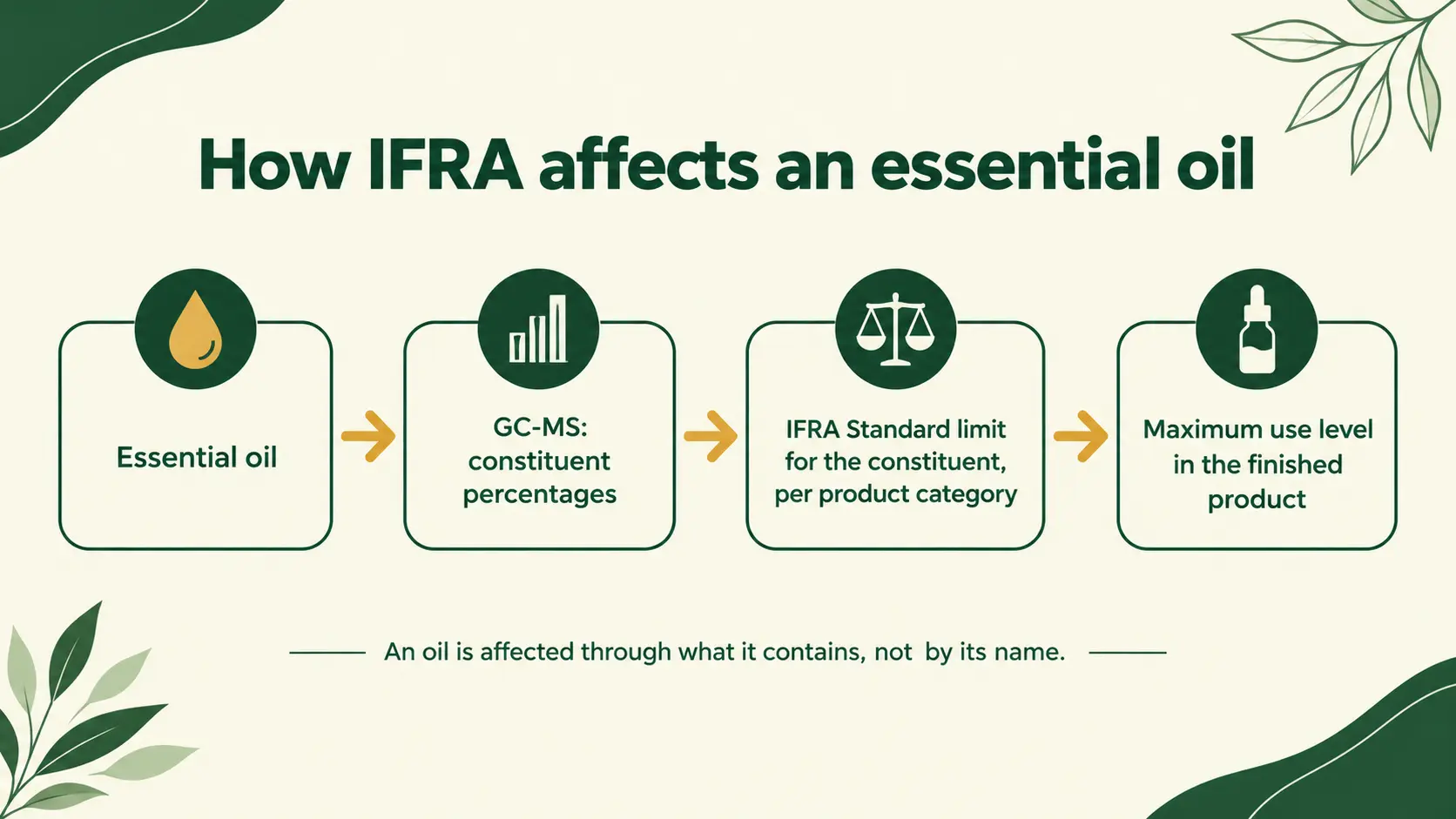
A summary from the testing and consulting group Wessling names five revised ingredients whose maximum levels were lowered: eugenol, geraniol, farnesol, methyleugenol and estragole. All five occur in natural materials. As general composition knowledge, not an IFRA list:
| Constituent | Oils where it is commonly a major component |
|---|
| Eugenol | Clove bud and clove leaf oils |
| Geraniol | Palmarosa, rose geranium and rose-type oils |
| Methyleugenol | Basil, nutmeg and pimento (allspice) oils, and in smaller amounts rose-type oils |
| Farnesol | Usually a minor constituent of neroli, rose-type and ambrette seed oils |
| Estragole | Basil (methyl chavicol type) and tarragon oils |
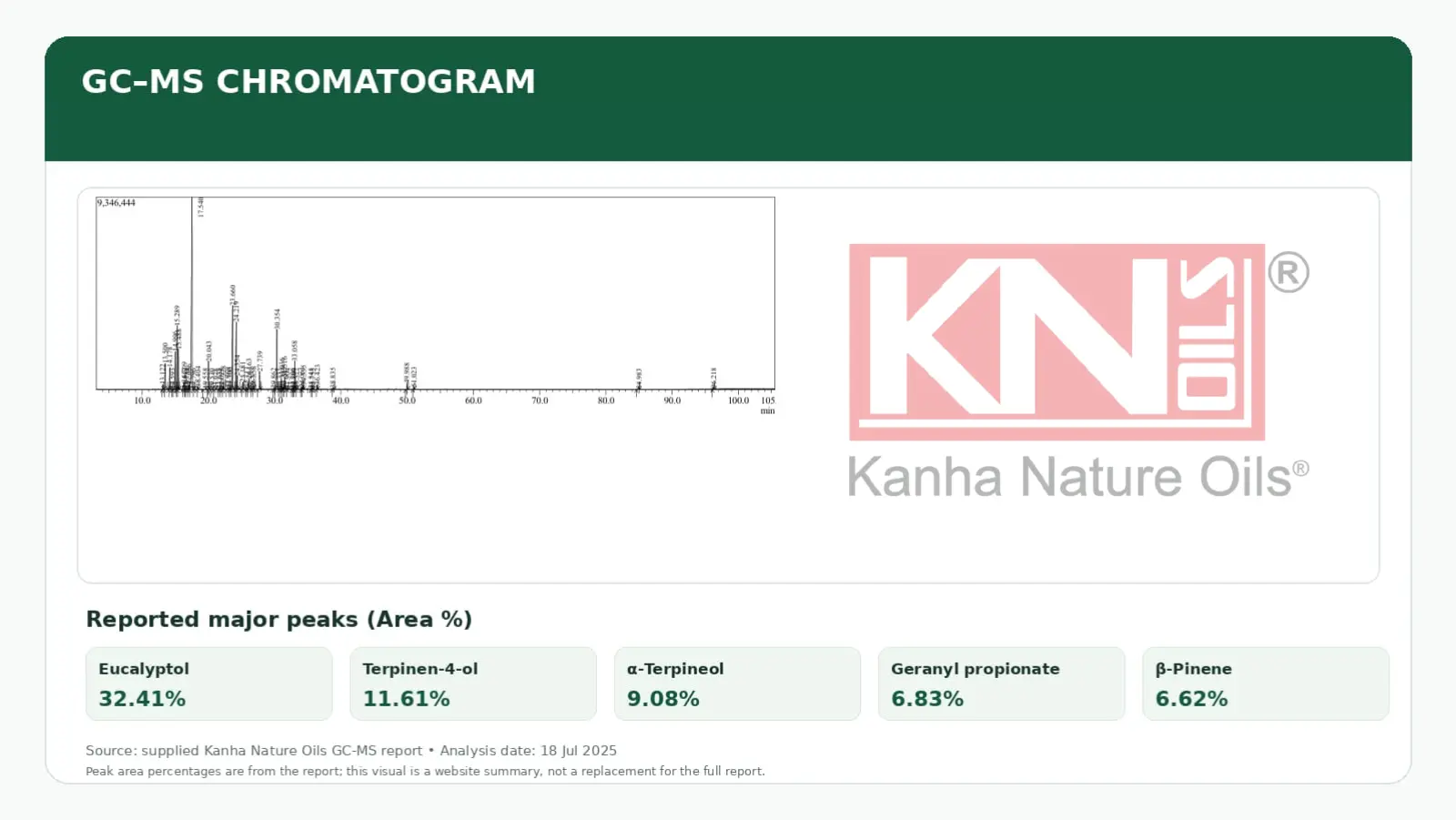
Composition shifts with species, origin, harvest and distillation, so this table only points you toward oils worth checking. The deciding evidence is the GC-MS composition of the batch in front of you. The GC-MS buyer’s guide shows how to read the percentages. The limit then depends on the IFRA category, which is why a certificate lists levels per category.
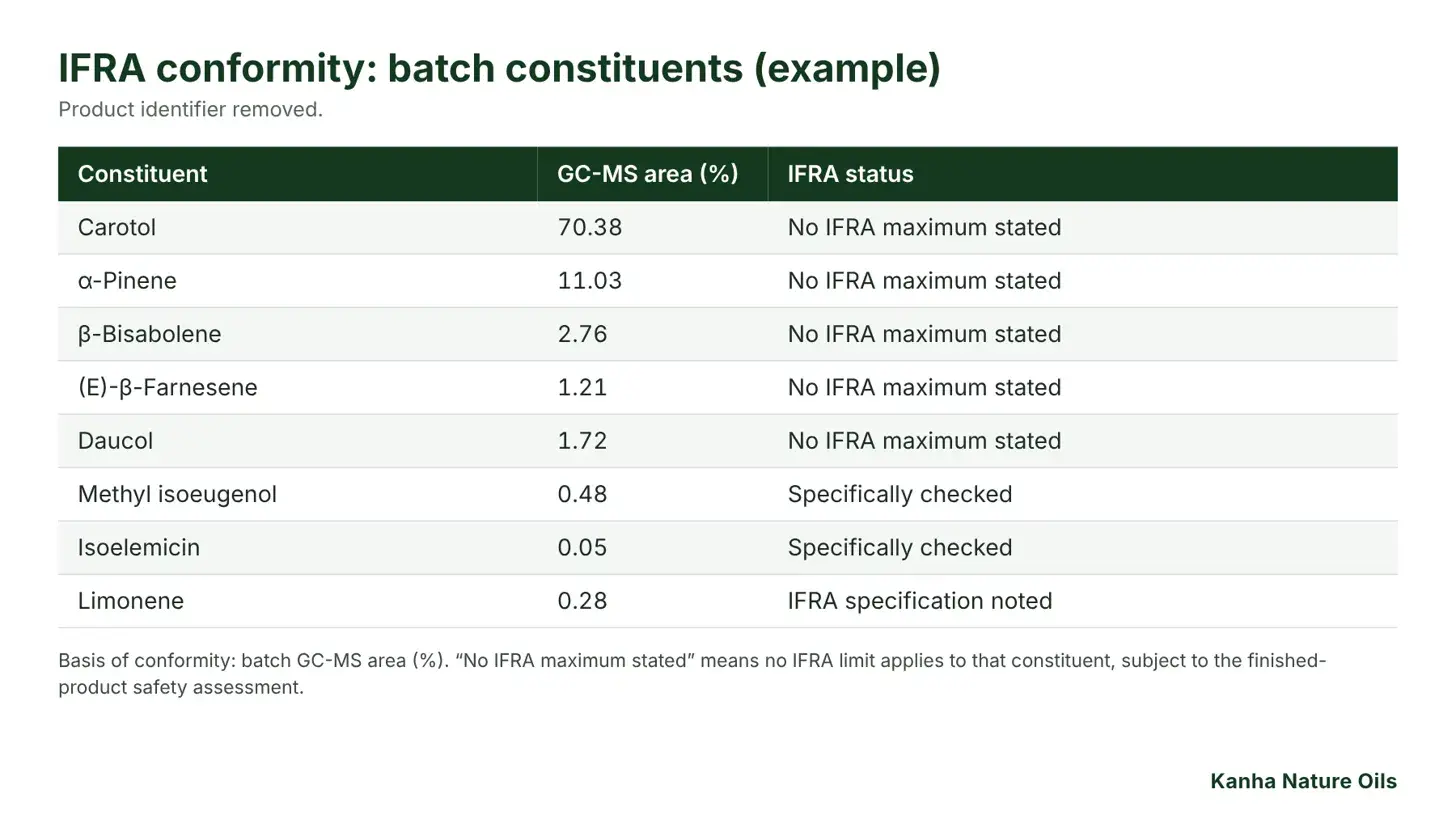
Constituent table only. The full certificate also carries the amendment number and category limits.
IFRA compliance matters most when an oil goes into perfumes, cosmetics, candles or other consumer products. For cosmetic formulators, see our notes on essential oils for cosmetic formulation.
IFRA 51st Amendment essential oils compliance: what your supplier must send you
These are the documents a careful buyer should require before payment.
| Document | What to check on it |
|---|
| IFRA Certificate of Conformity | Names the 51st Amendment; product name and code; issue date; maximum use level for each IFRA category; the limiting (binding) constituent behind each level |
| COA with GC-MS | Batch or lot number matches your consignment; constituent percentages that support the certificate |
| Allergen declaration | For cosmetics sold in the EU or UK: covers the expanded list under Regulation (EU) 2023/1545 (more than 80 substances, up from 26) |
| SDS (Safety Data Sheet, still widely called MSDS) | 16-section format; classification consistent with the composition |
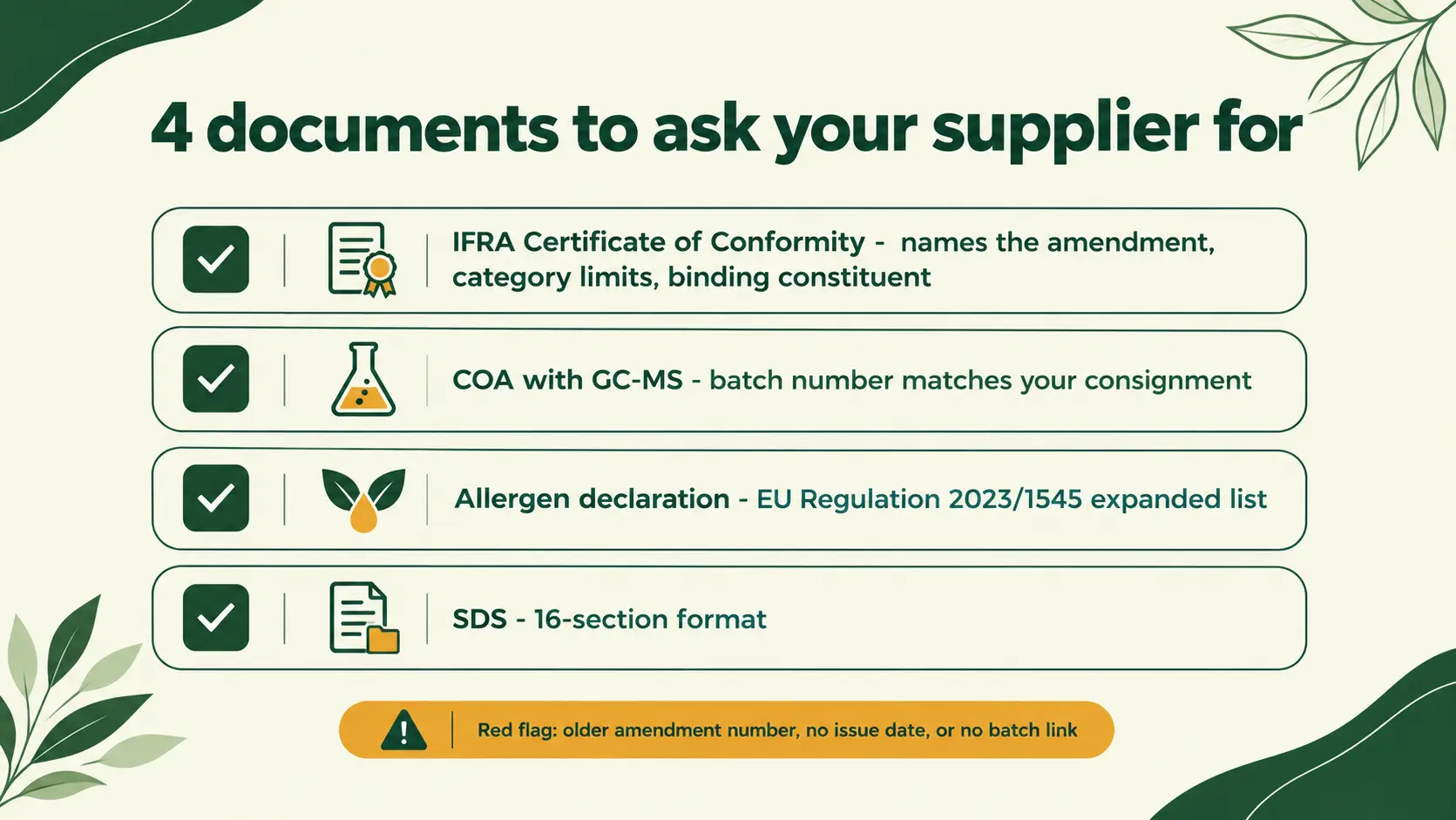
Red flags worth acting on:
| Red flag | Why it matters |
|---|
| A certificate that cites an older amendment number, or no amendment at all | It may not reflect the Standards now in force |
| No issue date, no category table, or only a generic “IFRA compliant” statement | There is nothing you can check against your product category |
| A certificate not tied to the specific product, and ideally the batch, being shipped | Composition varies by batch, so conformity can too |
| A COA whose composition could not produce the maximum levels on the certificate | The two documents contradict each other |
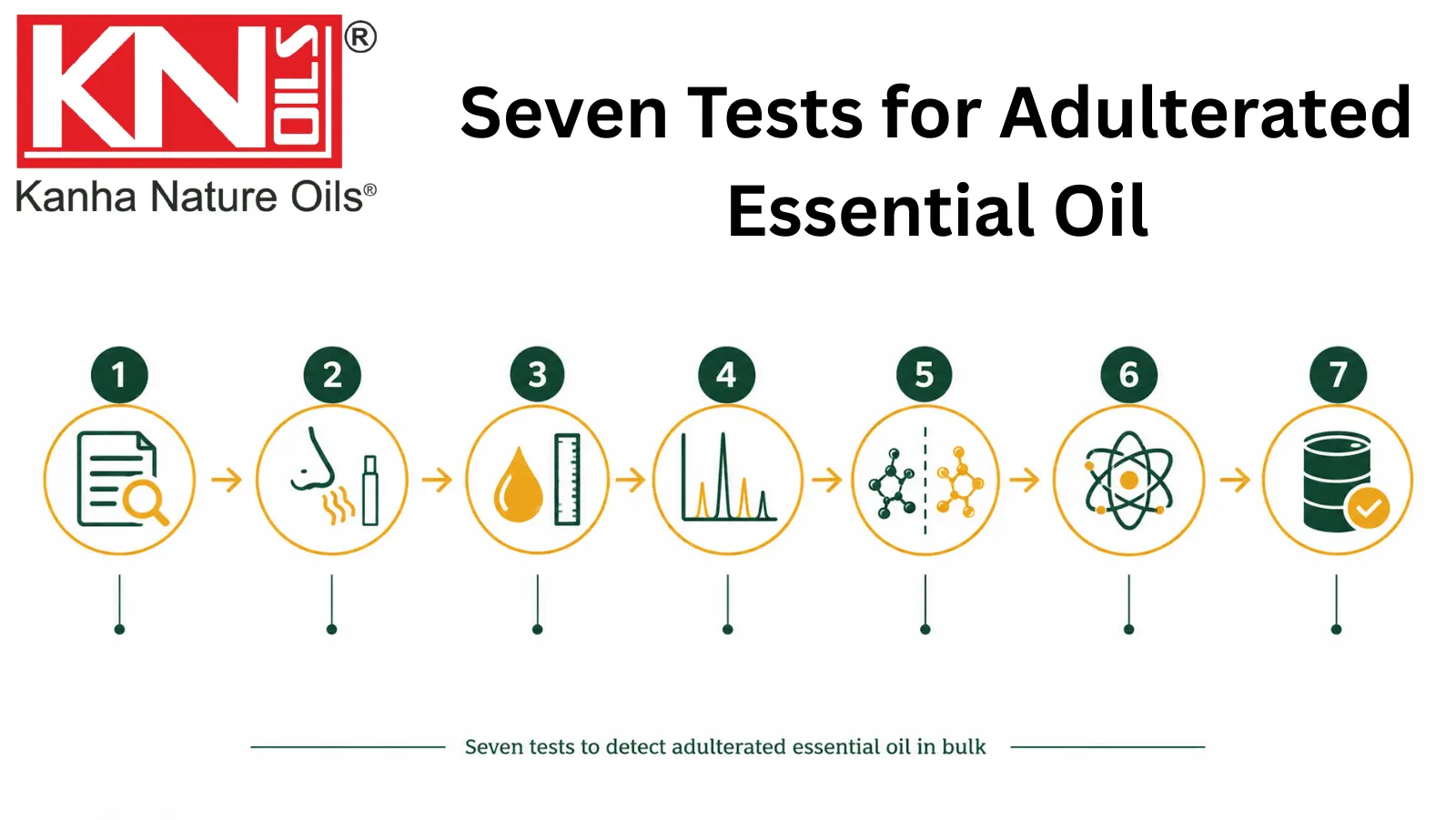
The full checklist is in our guide to the four documents to demand before you order. To check the oil itself, see the seven adulteration tests.
What is coming: the 52nd Amendment
A certificate written against the 51st is correct today but will not stay current. According to IFRA’s end-of-consultation letter, published 31 August 2026, the 52nd Amendment includes:
| Change | Detail |
|---|
| New restriction Standards | 48, for dermal sensitisation; 37 of them also assess systemic toxicity |
| Revised restriction Standards | 15, after updated RIFM assessments |
| Musk ketone | Revised from a specification-only Standard to one with restrictions |
| Acetylated vetiver oil | Revision adding a specification: the material should be stabilised by adding 1% alpha-tocopherol at the time of production |
| Phototoxicity | Three Standards revised: the renamed “Furocoumarins in Natural Complex Substances” (formerly “Citrus oils and other furocoumarin containing essential oils”), Tagetes oil and absolute, and Methyl N-methylanthranilate |
The eight oils named in the 52nd Amendment
The renamed furocoumarin Standard leads to the withdrawal of eight oil-specific Standards:
| Oil Standard being withdrawn |
|---|
| Angelica root oil |
| Bergamot oil, expressed |
| Bitter orange peel oil, expressed |
| Cumin oil |
| Grapefruit oil, expressed |
| Lemon oil, cold expressed |
| Lime oil, expressed |
| Rue oil |
Withdrawn here means these eight Standards are folded into the renamed furocoumarin Standard. It does not mean the oils become unrestricted. If you buy any of them, such as cumin seed oil from our second site, ask your supplier how its certificates will cite the new Standard, and check the final wording when IFRA notifies. If you buy Tagetes (marigold) materials, the same applies to the revised Tagetes Standard.
IFRA expects formal notification in January 2027. Entry into force is 11 months after notification for new creations and 30 months for existing ones. If notification arrives in mid-January, that implies roughly December 2027 and mid-2029; that is our arithmetic, not an IFRA date. For long-term orders, ask when your supplier will reissue certificates against the 52nd.
How Kanha Nature Oils handles IFRA documentation
Kanha Nature Oils’ IFRA certificates are written against the 51st Amendment and list per-category maximum use levels and the binding constituent. Allergen declarations cover the expanded list under Regulation (EU) 2023/1545, and SDS follow the 16-section EU format. All documents, including the COA and GC-MS report, are issued on request for the specific product and batch, so ask for them with your sample or quote request.

Quality control laboratory, Bahadurgarh.
Choosing between essential oils and fragrance oils? See essential oils vs fragrance oils, or browse our essential oils range and the natural essential oil catalogue on our second site.
Frequently asked questions
Is the IFRA 51st Amendment a law?
No. IFRA Standards are an industry safety programme. Regulators in some markets reference them, and many brands and retailers require compliance contractually, so for most B2B buyers they behave like a requirement.
Which essential oils are banned by the 51st Amendment?
IFRA’s public summary names no essential oils. It prohibited one fragrance ingredient. Whether an oil is exposed depends on whether it contains a restricted ingredient at a level that breaches the limit for your product category.
Is the 51st Amendment still the current one?
Yes. As of 17 October 2026, IFRA’s Standards page still lists the 51st as the latest amendment. The 52nd has completed consultation but is not yet formally notified; notification is expected in January 2027.
Which oils does the 52nd Amendment name?
Eight: angelica root, bergamot (expressed), bitter orange peel (expressed), cumin, grapefruit (expressed), lemon (cold expressed), lime (expressed) and rue. Their individual Standards are folded into a renamed furocoumarin Standard, so the oils are not unrestricted.
What is an IFRA Certificate of Conformity?
It is a supplier’s statement that a specific material complies with the IFRA Standards in force, showing the amendment number and the maximum use level for each product category. IFRA publishes a template on its Standards page.
About Kanha Nature Oils
Kanha Nature Oils manufactures and exports 700+ products, including essential oils, attars, hydrosols, floral absolutes, spice oils and carrier oils, from Bahadurgarh, India, and supplies buyers in 60+ countries. The company is ISO 9001:2015, ISO 14001:2015, WHO-GMP, HACCP, KOSHER and HALAL certified. COA, GC-MS report, SDS and IFRA certificate are issued on request for the specific product and batch.
We don’t ask you to trust us. We ask you to test us.
Request a sample with its IFRA certificate and GC-MS report, or ask for a bulk quote, through our contact page.
Email: info@aromatherapyoil.in
Phone: +91 98108 05866
Unit-1: Adjoining HUDA Plot No. 682, M.I.E. Part-1, Bahadurgarh, Haryana – 124507
Unit-2: 677, M.I.E., Part-1, Bahadurgarh, Haryana – 124507
Website: kanhanatureoils.com | aromatherapyoil.in