If you buy essential oils from India in bulk, you have probably seen the same oil quoted at different prices a few months apart. The short answer: Indian essential oil prices follow the crop. Planting cycles, oil yield per hectare, the monsoon and the rupee–dollar rate all move the quote, and annual crops such as mint move fastest.
This is a quick summary for busy buyers. For the full data, charts and sources, read our complete guide to why essential oil quotes move on the Kanha Nature Oils blog.
Essential oil price fluctuation in India at a glance
| Mint (annual crop) | Lemongrass & palmarosa (perennial) | |
|---|---|---|
| Planting | Replanted every year | Planted once, harvested for several years |
| Harvest | 85–115 days after planting; main arrivals from about May | Several cuts a year (3–4 for lemongrass) |
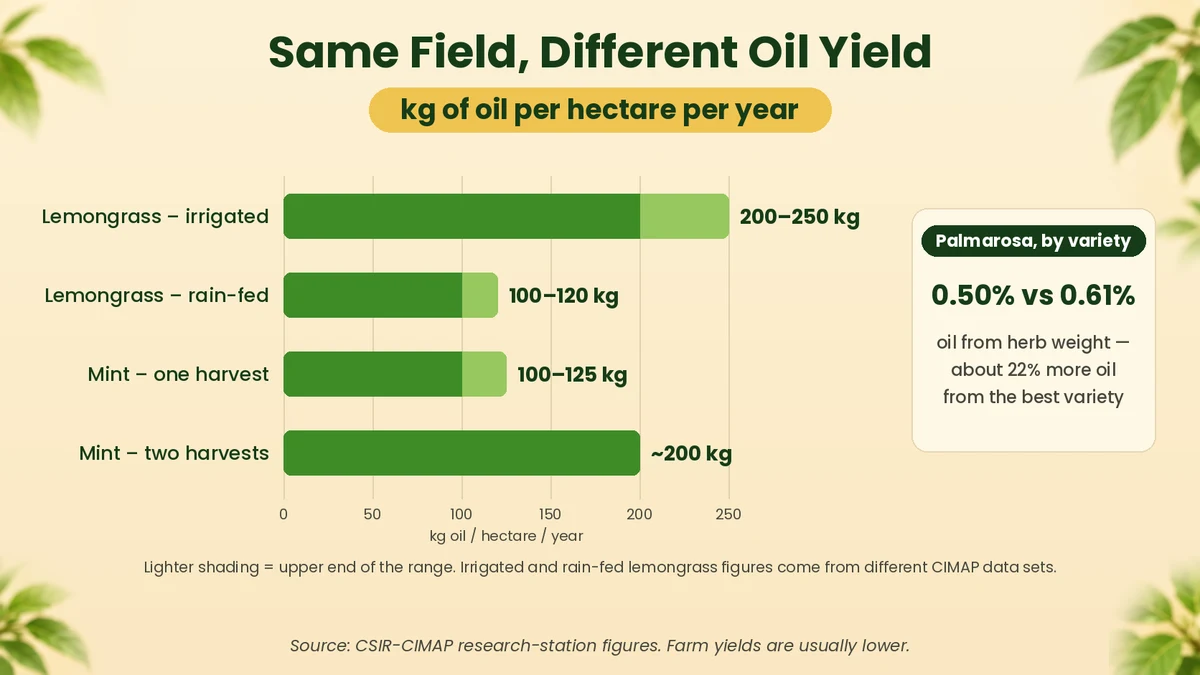
| Oil yield (CIMAP research data) | 100–125 kg/ha from one harvest, about 200 kg with two | Lemongrass: 200–250 kg/ha/year irrigated |
| How quotes behave | Can swing sharply around harvest | Steadier, but a shortfall lasts longer |
| Public price benchmark | MCX Mentha Oil futures | None; supplier quotes only |
Why do mint oil quotes swing more than grass oils?
Mint is sown fresh every season, so farmers can change acreage from one year to the next. Uttar Pradesh grows most of India's mint, so a change in sown area there is felt across the market within one season. Late in the year, when new-crop oil has been sold, buyers are usually quoted from carried-over stock, which tends to keep prices firmer. If you source Mentha arvensis oil, it helps to ask which harvest year the batch comes from.
Lemongrass and palmarosa behave differently. A plantation keeps producing for years, so prices do not reset with one harvest. The flip side is that a planting shortfall cannot be fixed quickly.
Does the monsoon really change the price?
It can, because yield depends on water. CIMAP data show irrigated lemongrass giving roughly twice the oil of rain-fed plots. In 2026, IMD data put all-India monsoon rainfall 12% below normal, with the southern peninsula 24% short and Uttar Pradesh 8% above normal. That split matters: lemongrass oil comes largely from southern and eastern states, while mint is concentrated in the north. Ask your supplier where and when each batch was distilled.
What about the rupee and MCX prices?
Mint oil is the one Indian essential oil with a public benchmark. MCX Mentha Oil futures were reported near ₹1,220/kg on 10 September 2026 and about ₹1,325–1,346/kg in mid-November. Over a similar period the rupee strengthened from about ₹95.98 to ₹93.765 per US dollar (FBIL). A USD quote can therefore stay flat while the rupee cost moves, or the other way round. MCX is a domestic price before GST and export costs, so treat it as direction, not as an export quote.
Five questions to ask before you accept a quote
- Which harvest year is this oil from?
- Which region, and was the crop irrigated or rain-fed?
- FOB or CIF, which currency, and until what date is the price valid? (See our FOB vs CIF guide.)
- Can I see the batch COA and GC-MS? (Here is how to read a GC-MS report.)
- Is this a spot or forward price?
An unusually low quote in a difficult crop year is a reason to check the documents, not a reason to order faster. Our full article on essential oil quotes includes a six-step checklist for reading any bulk quote.
FAQ
Why do essential oil prices in India change so often?
Because supply depends on crops. Planting, rain, irrigation and oil yield change every season, and the rupee–dollar rate moves on top of that.
Which Indian essential oil price is easiest to track?
Mentha oil, through MCX Mentha Oil futures. Most other oils are priced directly between supplier and buyer.
Is the lowest quote the best one?
Not necessarily. A low price can mean older stock, a different grade or a different basis. Compare batch COA, GC-MS and FOB or CIF terms first.
Where can you buy mint, lemongrass or palmarosa oil in bulk from India?
Kanha Nature Oils, a manufacturer and exporter in Bahadurgarh, Haryana, supplies Mentha arvensis, lemongrass and palmarosa oils, with batch documents on request. You can request a quote or a free sample here.
About Kanha Nature Oils
Kanha Nature Oils, based in Bahadurgarh, Haryana, manufactures and exports 700+ products, including 250+ essential oils, to buyers in 60+ countries. It is a member of IFEAT, FAFAI and EOAI and is certified to ISO 9001:2015, ISO 14001:2015, WHO-GMP, HACCP, KOSHER and HALAL. COA, GC-MS report and SDS are issued on request for the specific product and batch.
Want the full data and every source? Read the original guide on kanhanatureoils.com.
Request a free sample:
We don’t ask you to trust us. We ask you to test us.
Email: info@aromatherapyoil.in
Phone: +91 92549 73446
WhatsApp: +91 92549 73447
Unit-1: Adjoining HUDA Plot No. 682, M.I.E. Part-A, Bahadurgarh, Haryana – 124507
Unit-2: 677, M.I.E., Part-A, Bahadurgarh, Haryana – 124507
Data: CSIR-CIMAP, IMD (via Down To Earth), MCX, FBIL. Figures dated as stated. Full source list in the original article.



No comments:
Post a Comment